




Implementing Odoo in your organisation? Here's what you need to consider
More and more organisations are investing in digitalisation to streamline their processes and make them scalable. ERP systems play a central role in this, and Odoo is an attractive choice for many businesses. The platform combines domains such as CRM, HRM and accounting in one accessible and modular system that grows alongside the needs of an organisation. But it is precisely that flexibility and versatility that set Odoo apart, which also make the platform more complex than it first looks. Are you considering Odoo as an all-in-one solution for your business operations? Here's what you need to take into account, according to our experts.
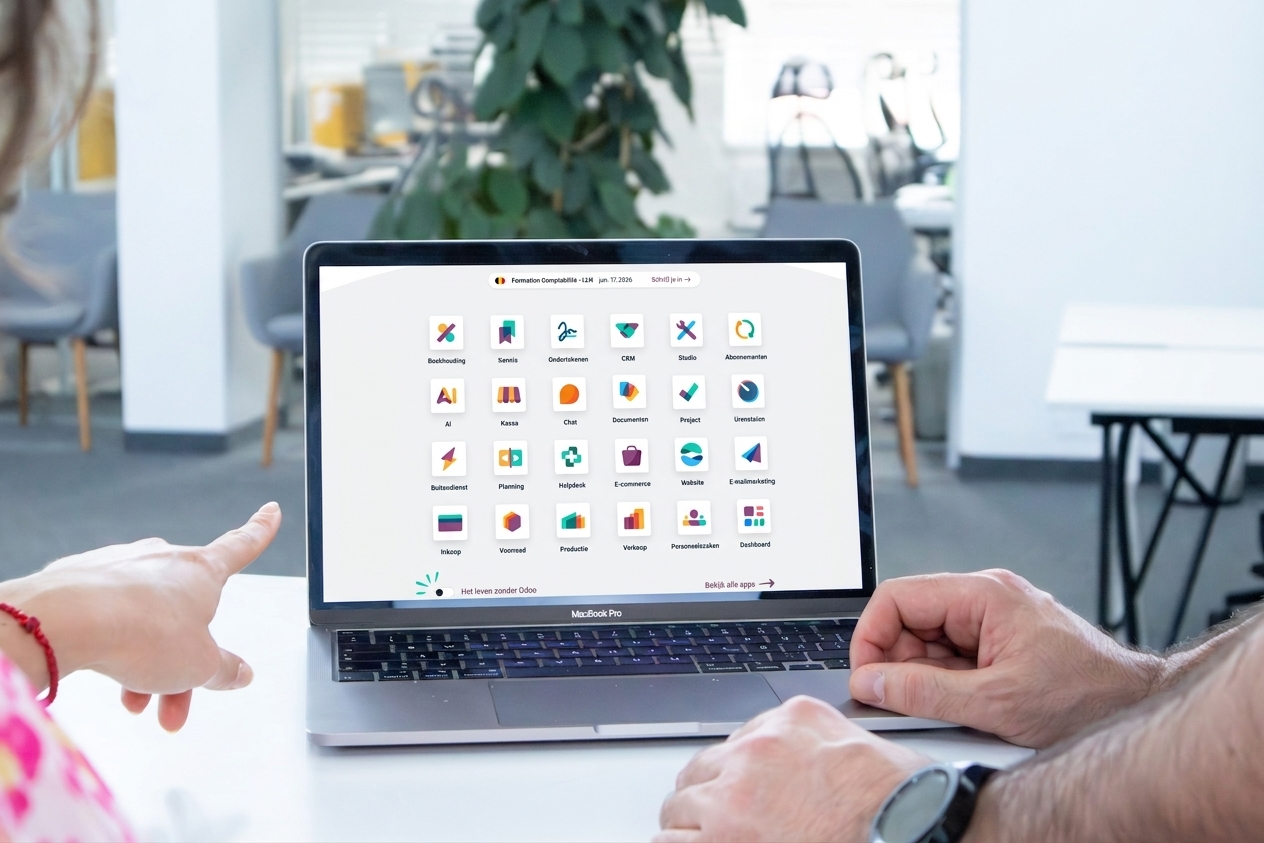

The power and pitfall of flexibility
Odoo allows for a lot of configuration and extensions. Thanks to its open nature and broad functionality, you can set up a modular system that fits your organisation perfectly. Sounds great, doesn't it? But that's precisely where the risk lies as well.
Companies often start from a specific need, for example invoicing, stock management or CRM. They select the corresponding module for each of these needs and build on it step by step. However, if you don't have a clear roadmap from the get-go, you end up building solutions that work individually but fail to form a coherent system. The result? Complexity, inefficiency and, ultimately, higher costs to straighten everything out again.
The difference between a technical problem and the real problem
In Odoo, you can personalise workflows by adding extra fields, activating functionalities or even building custom scripts. But is that always necessary? One of the biggest pitfalls in ERP implementations is starting from a technical problem rather than from the underlying business need. For example, when the accounting department requests an extra field to enter certain data, that's possible. But why do they need that field? What process sits behind it? And is an extra field really the most efficient way to support that process? In many cases, the solution is closer to the standard functionality than expected, but we overlook it because the focus shifts too quickly towards customisation.
Data is available, but insight is not a given
Another one Odoo's strengths is the accessibility of data. An ERP system allows you to integrate various core processes such as finance, HR, purchasing, sales, production and logistics, resulting in one rich, central database. This enables departments to collaborate in real time, helps teams avoid duplicate work and incorrect data, and provides richer datasets. But more data does not necessarily lead to better insights. The real added value only emerges when you understand which data are relevant, interpret them correctly and translate them into concrete management decisions. Without that analytical insight, an ERP system remains primarily a registration tool rather than a strategic instrument.
Odoo as a quick fix?
Odoo often enters the picture when organisations want to move from multiple tools to a single all-in-one platform. Because start-ups and SMEs operate with limited resources, small teams and a hyperfocus on their core activities, a complex technology landscape frequently develops. When they encounter a problem, they look for a solution that allows them to move forward. As a result, their software landscape tends to grow step by step, without every choice around tools or processes being thoroughly thought through. That works, until it no longer does and they need to look for a more future-proof alternative. Odoo can be an interesting solution, but it is not a small decision. Every migration from such a complex technology landscape has an undeniable impact on various processes, teams and tools. A successful transition to Odoo requires a well-considered trajectory that pays attention to both the technical and the business side.
Why a purely technical implementation is not enough
How do you successfully approach a move to Odoo? First and foremost, a technical implementation partner is far from a luxury. They help you set up Odoo correctly from a technical standpoint. However, it is worth being critical when reviewing their proposals, particularly when it comes to customisation versus Odoo's standard functionalities. Because often the solution is already built into the system as standard, but you need the right expertise to find it.
Alongside a technical implementation partner, it is therefore wise to also seek a partner who looks beyond technical implementation alone. Someone who can safeguard your interests and translate your ideal workflows into clear technical roadmaps.
How we can help you
We can act as the external partner who takes into account the technical and business side of things. Unikoo is not an Odoo implementation partner. In fact, we will certainly not recommend this all-in-one software to every organisation. But if Odoo does turn out to be a good fit for your organisation, we provide appropriate guidance throughout the process. With our broad expertise in finance, administration, HR, marketing and tech, we can advise on an Odoo architecture that suits your organisation.
Our Finance consultants have extensive experience with Odoo. They know how to leverage Odoo to quickly gain financial insights and set up reporting. With new implementations, they also advise on how to structure financial processes efficiently within the tool. With our broad expertise in finance, admin, HR, marketing and tech, Unikoo can moreover translate wide-ranging operational insights into an Odoo architecture that suits your organisation.
Our fractional CTOs help objectively select the right technical implementation partner, oversee the coherence between processes and systems, and ensure the implementation runs smoothly. Acting as a temporary or part-time CTO, we serve as an independent right hand that asks critical questions, assesses the impact of decisions, and ensures the project remains technically feasible, clear, and future-proof, without you having to hire that expertise in-house.
Conclusion
Odoo can be an exceptionally powerful platform for organisations looking to digitalise and grow. Its flexible and modular system allows you to gradually expand the software as the organisation grows and needs evolve. But that power only comes into its own when technology and business reinforce one another. When you make conscious choices about what you build and what you choose not to build. A pragmatic approach, combined with sufficient technological knowledge, makes all the difference here: use standard functionality wherever possible, avoid unnecessary customisation and think ahead, but build in phases.
Are you interested in Odoo to streamline various aspects of your organisation, or are you looking for a partner to guide you towards digitalisation and workflow optimisation? We will explore together with you whether Odoo is the right fit and support you throughout the entire process.


